Why that "authorized service center" line on your invoice actually matters
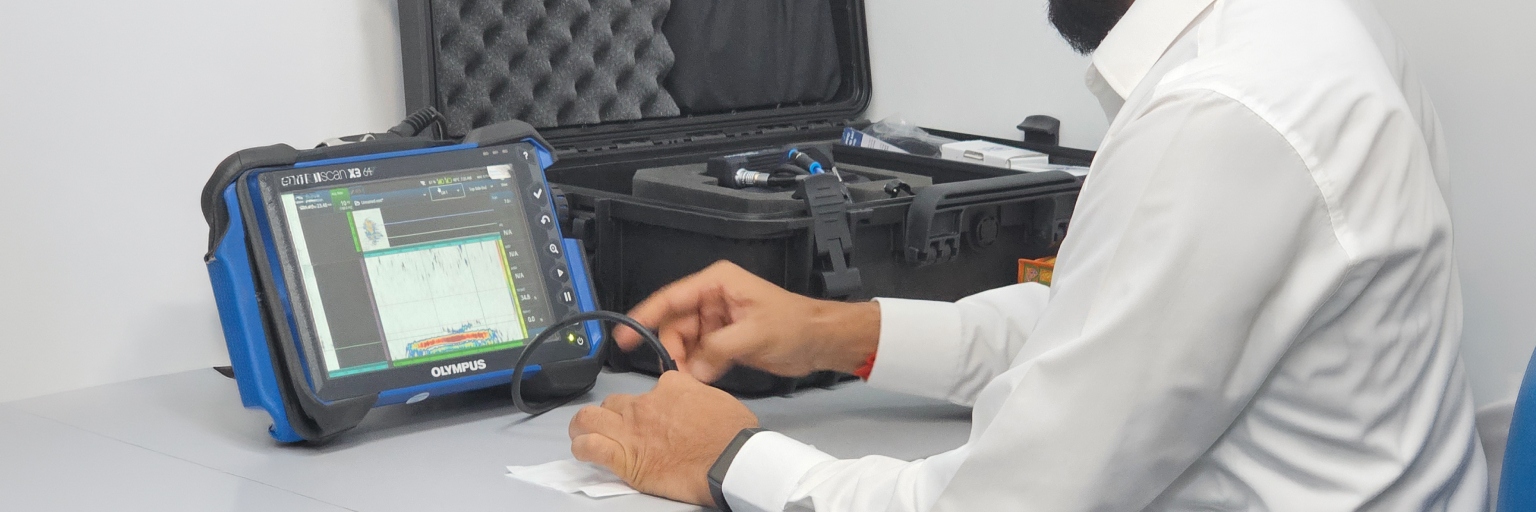
A weld inspector running a phased array flaw detector on a thick-walled joint won't get a warning light when something's off. The scan still renders, the report still generates - but if the probe isn't performing at full resolution, a small crack indication can look like background noise instead of a clear defect. Nobody catches it on-site. Someone catches it later, usually during a failure review, asking why an inspection that passed didn't hold up.
That's the risk with ultrasonic and phased array NDT: the equipment rarely fails outright. It drifts, quietly, until a reading that looks fine isn't.
What "authorized" is actually protecting
Ultrasonic testing works by sending high-frequency sound waves through a material and reading the echoes that bounce back, which means the entire result depends on the instrument's calibration being exactly right, not approximately right. A flaw detector like the OmniScan X3 64 is built to exploit a full 64-element phased array aperture and up to 128-element TFM imaging precisely because half-measures in resolution mean missed or misclassified indications.
That precision is what an authorized NDT equipment service center is actually protecting. A general repair shop can usually get a flaw detector powered on and scanning again. What it can't do is confirm the probe response, the focal law calculations, and the image resolution are still trustworthy at the level the inspection standard requires. For welds in oil and gas piping, pressure vessels, or civil infrastructure, that gap is the difference between a defensible report and one that only looks like one.
Where it shows up beyond the flaw detector
The same logic extends to the wider set of instruments a site depends on. Eddy current testing, used for flaws in conductive materials, has its own calibration sensitivities. So does the surveying equipment - total stations, levels, positioning instruments - that crews use to set reference points before any NDT work even begins. The same logic applies to surveying equipment. Total stations, levels, and positioning instruments need the same discipline, which is exactly what an authorized surveying equipment repair provider in the UAE offers.
Before your next service or parts order, it's worth checking:
• Is the technician trained and certified on your specific instrument, not general electronics?
• Are replacement parts sourced from the original manufacturer, with traceability?
• Does the service include documented recalibration, or just a functional test?
• Is there a maintenance history on file, so drift over time can actually be tracked?
Nearly two decades of doing this the boring, correct way
Sigma Enterprises has served as a local partner for global technology solutions in the UAE since 2006, and is the authorized distributor for Evident (formerly Olympus) NDT products in the region, including the OmniScan X3 and X4 flaw detector series. Alongside
NDT inspection, Sigma's portfolio covers advanced positioning and surveying instruments, robotics and drone technology, and civil testing equipment, serving sectors like oil and gas, defence and security, and civil infrastructure.
Being an Evident authorized service center means product maintenance and calibration happen both at Sigma's premises and on-site, backed by a spare parts inventory maintained specifically to avoid the delays that cost clients more than the part itself. That combination - trained technicians, genuine parts, and documented calibration - is what NDT equipment maintenance in the UAE is supposed to mean, even if not every provider treats it that way.
An inspection report is only as good as the instrument that produced it. So the question worth asking before the next service isn't who's fastest or cheapest, it's who can actually stand behind the numbers once the equipment comes back.