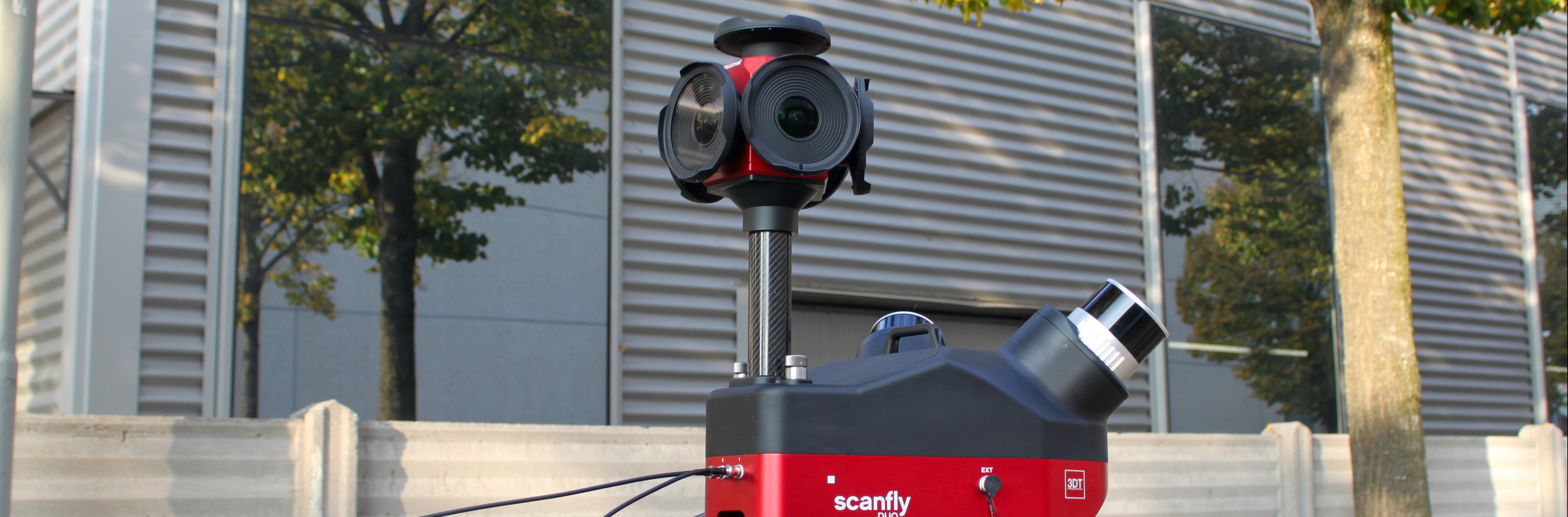
Picture two sites on the same week's schedule. One is an occupied office floor that needs documenting without disturbing anyone. The other is a plant room packed with thin pipework, bolts and tight assemblies. You wouldn't capture both the same way, and that is the thinking behind NavVis's two newest additions: the NavVis CLX and the NavVis VLX 4.
for your team, here is what each device does, where it fits, and how it gets you from site to deliverable.
The NavVis CLX is a handheld reality capture device built for high-volume, everyday documentation. It isn't chasing the maximum possible detail. Its job is to make capture simple, repeatable and dependable. It's light and ergonomic, so it works in occupied or confined spaces. Its dual lidar setup and live 2D and 3D coverage view let the operator check that nothing was missed before leaving the room.
The NavVis VLX 4 is a wearable scanner built for the opposite end of the spectrum. It delivers true 3 mm point cloud resolution through three lidar sensors, and it captures while the operator simply walks. Thin pipes, bolts, sharp edges and complex assemblies come through clearly. This is the scanner you'd reach for when the model downstream has to show small components accurately, such as fittings, fasteners and tightly packed services.
So which one do you need? That depends less on the scanner than on what the data has to do afterwards.
Where each one earns its place
• NavVis CLX: area referencing, site assessment, quantity surveying support and LOD200 scan-to-CAD/BIM. Think repeatable jobs, many sites, and operators who need to be productive quickly.
• NavVis VLX 4: plant rooms, industrial facilities and technical interiors where fine geometry matters. The triple-lidar design captures complex shapes from several angles in a single pass, which means cleaner, more complete point clouds.
Teams often ask whether they must pick one. Not necessarily. A firm that surveys dozens of buildings a month and occasionally takes on a detailed industrial retrofit may find the two complement each other. They answer different questions.
How the data moves from capture to deliverable
A scanner is only half the story. Once a site is captured, the data has to be processed, aligned and shared, and this is where workflows often slow down.
NavVis approaches this as three connected steps: capture, process and access. Scan data from the devices is processed and automatically aligned, and the results go into IVION. There, point clouds and panoramic images become spaces that anyone on the project can open from a standard web browser. Designers, site managers and clients can all look at the same source of truth, instead of passing files around.
The practical benefit is fewer manual handovers. With less cleanup and less re-explaining between teams, the project keeps moving from site to final output.
Choosing with confidence
Before committing to any
3D laser scanner, it helps to ask three plain questions:
1. What level of detail will the final model need: documentation-grade or LOD350+?
2. Will operators be working in occupied, tight or industrial spaces?
3. How many sites will you be capturing, and how quickly do new team members need to be productive?
Your answers usually point to a device. If they don't, seeing the scanners in action settles it faster than any spec sheet.
See them on your own kind of site
At Sigma Enterprises, we've been a local partner for global technology solutions across the UAE and GCC since 2006. Laser scanning is a field where the right match between tool and task saves real time, so we run live product demonstrations to answer your questions before you commit. We also support customers with training, application support, and calibration and maintenance after the purchase.
If you're deciding between the NavVis CLX and VLX 4, or wondering where 3D scanning fits into your next project, book a demo with us at Navvis Distributor in UAE | Sigma Enterprises |
Sigma Enterprises LLC and test them against your actual workflow.